Monday, June 22, 2015
Mercury Rising
It's tough keeping up with the latest changes in ecological correctness. As we remodeled the downstairs kitchen, we removed all of the fluorescent ceiling lights. The Health Dept. says we can't have bare bulbs in a food-preparation facility, presumably because the bulbs might spontaneously shatter and fall into the food. Okay, but since we couldn't find any light covers that fit, the entire fixture had to come out.
We had a total of three big fixtures, each one with fluorescent tubes that are six feet long (!). Taking down the fixtures is easy. It's disposing of the bulbs that's tricky. Standing up on the ladder, reaching over my head, I was scared that I'd drop one of these things and it would shatter into a million pieces all over the kitchen floor. Turns out, that's not really a problem.
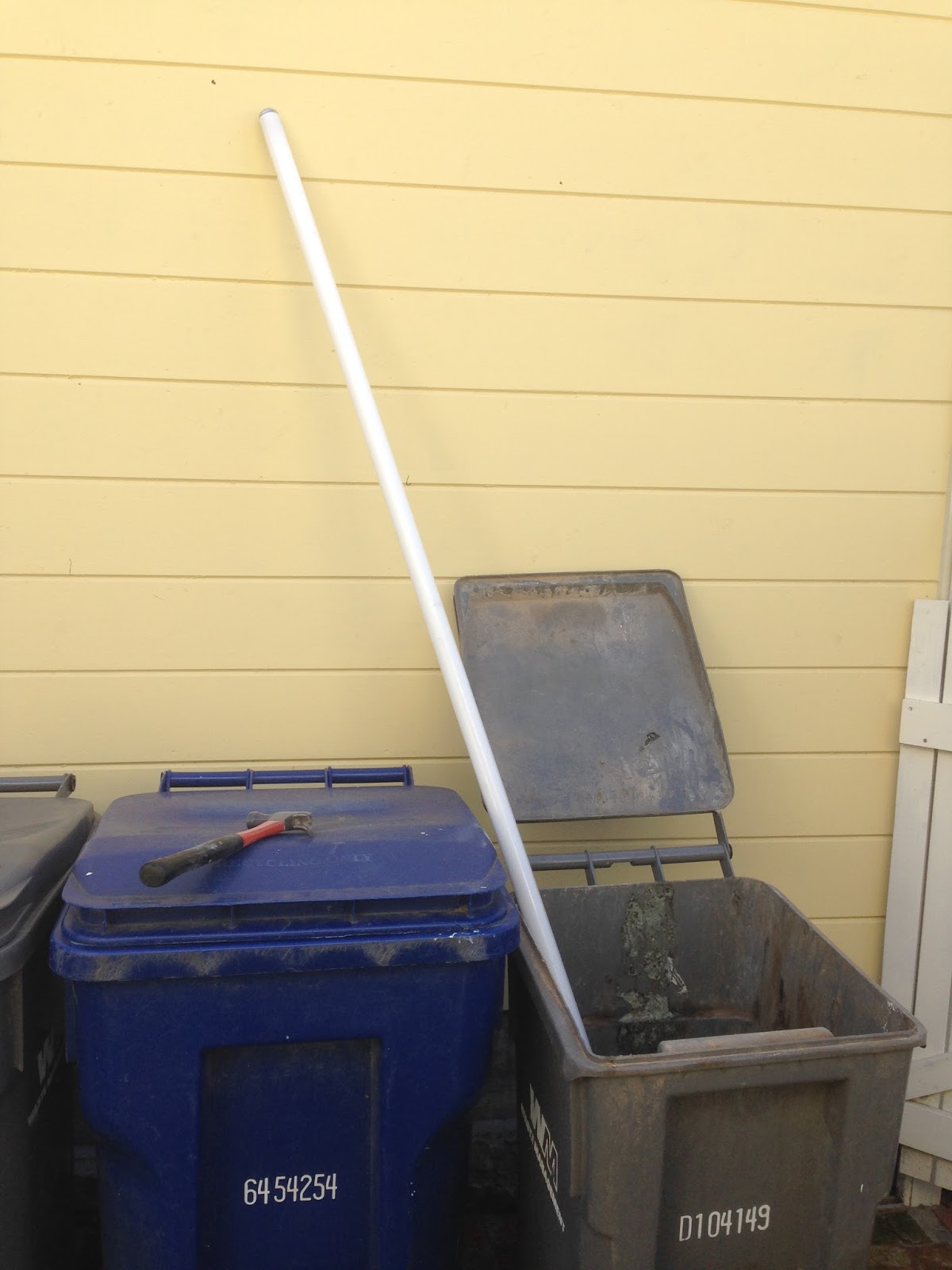
Once I got the bulbs down, I tossed them into the garbage can, thinking they'd break up into little glass shards. Nope. These things are surprisingly tough. Ironically, they're tougher than the plastic "safety covers" that go over them, so the Health Dept. might want to rethink its rules.
Since they didn't politely crumble into pieces when we threw them away, I put on a pair of goggles, wore heavy gloves, and wrapped an old blanket around each tube and hit it with a hammer. You know, kind of a gentle tap, tap, tap. Not good enough. Hit it a little harder. Knock, knock, knock. Still no good. Finally, I took a big swing and really pounded the thing and then it broke. Jeez, these things could be used in track & field events as vaulting poles. They're tough.
They also give off a lot of white dust when they break, kind of like hitting two chalkboard erasers together. I'm certain the dust is poisonous, but I was outside so that makes it okay, right?
Thursday, May 14, 2015
The Storm Before the Calm
You know how it seems like distant deadlines are always a long way off? Like you have all the time in the world to finish that report, or build that bench, or clean up the guest room before company comes because, hey, they're not coming for another two months, right?
And then the deadline sneaks up on you.
Kathy picked Mother's Day weekend (May 9-10) for our grand opening, and we figured that gave us plenty of time for those one or two little things that still needed to be completed. How tough can it be? But as the date approached, we realized there were all sorts of little things that still needed attention. So it started to get a bit frantic around here. Not enough teacups. Need to order butter. Got to buy strawberries, but not too early or they'll go bad. The floor needs cleaning. Where are we going to put the big water urns for making tea? I know; let's build a table for them and put it right here, but first we have to find table legs and then put together a table and then anchor it to the wall so the table doesn't fall over and spill all the hot water on the floor if someone catches an apron on it and where are the AC plugs for the stupid things and we're running out of time we haven't even started cooking yet and the phone is ringing and, oh yeah, what do we do with the phone if it rings while we're serving guests do we answer it or ignore it or turn off the ringer so nobody hears it, yeah that's a good idea but oh wait what if someone is calling to cancel their reservation we'd need to know that, but only if we're going to reassign the table to someone else but maybe we don't want to accept walk-ins on our first day so let's not do that and do we have enough milk?
Eventually we got on top of it. The house was all ready, the ingredients had all been ordered and delivered, some of the long-lead cooking had begun, the dishes were all washed (we had to wash all the brand new plates and glasses before first use), and the tables were set. Nothing can go wrong now.
Worst Job. In the World
As part of our initiation into the exciting new world of foodservice, Kathy and I were introduced to the concept of grease traps.
As the name might suggest, grease traps serve to, uh, trap grease. They're a necessary part of the plumbing in any restaurant because they prevent all the kitchen grease from going straight down the drain. In a normal home, that's not a problem. You can pour the occasional pan of bacon grease down the drain without major fear of clogging the municipal waste-treatment system. (It's still not a good idea, because you might clog your own drain, but that's not the city's problem.) But if every restaurant and coffee shop in town did the same thing, you'd have a major biohazard clogging the public sewer system. So you have to install grease traps.
I say grease traps, plural, because every drain pipe that exits the house needs its own grease trap. If you have two sinks, for example, they both need a grease trap. Otherwise, what would be the point? The local Health Department wants to make sure you're not tempted to pour the grease down that drain instead of this one and bypass the grease trap.
Fortunately for us, the house came with two grease traps already installed. Unfortunately for us, they're huge big ugly things that take up space in the backyard. Imagine a rusty steel coffin, about six feet long, three feet wide, and three feet high. So a duplex coffin, then. There's a big steel lid held down with bolts and wing nuts that unscrew (or would, if they weren't so rusty). Black. Rusty. Very heavy. And mandatory.
Expensive, too. We were told not to throw out the grease traps (as if "throwing out" a 300-pound object was an option) because they'd cost about $5000 to replace. Okay, then. We're keeping them right where they are.
So they've been sitting outside in the rain for the past several years, collecting rust... and grease. One of the two was disconnected from the household plumbing a long time ago when the previous restaurant decamped, so it's just sitting there taking up space. But the other one has been straining our downstairs kitchen water the whole time. And we've put some nasty stuff down that drain.
Anyway, before we could open the restaurant we had to get the grease trap(s) cleaned. That's part of the charm of grease traps: they filter out and accumulate all the icky stuff -- stuff too nasty for the sewer system, if that gives you any idea. So they need to be cleaned out on a regular basis.
There are people who do this for a living.
We're surrounded by restaurants here, so it wasn't hard to discover who cleans these things. Just watch out the window for a few days and, sure enough, you'll see the big tanker truck from Salinas Tallow Company show up, pull a hose around the back of the neighboring restaurant, and start pumping, ahem, "tallow" out of the grease traps. So we called the number on the side of the truck, made an appointment, and a few days later we met Steve.
Nice guy, Steve. But I gotta tell you, he has the world's worst job. Like being an Army private or a proctologist, I'm glad that there are people who do it, but I'm also glad that I'm not one of them. Steve can have my money. Just don't make me watch.
Actually, I did watch. Call it morbid curiosity, but I really wanted to know what the inside of our two big tanks looked like after years of restaurant service followed by years of neglect followed by years of our mistreatment of it. It hadn't been cleaned in at least 8 years -- our neighbors cleans his weekly -- and it's probably been longer than that. I doubt the restaurant cleaned out its grease traps on its final day of service. Who knows what kind of crud would be in there. Would there be a thick layer of fat? A toxic brew of chemicals? A decomposing body? And how bad would it smell? Little boys need to know this stuff.
Time to lift the lid. Steve and I took turns twisting off the rusty wing nuts from their heavy steel bolts. When that didn't work, we used a hammer to knock the bolts loose. When the last bolt came off and the lid was free I admit I took an involuntary step backwards.
The reality was... somehow disappointing.
The first trap, the unused one, was empty. Steve didn't even charge us to clean it. The second trap, the one that's been in service all this time, was full of water and a bit of floating debris, but nothing noxious or overly disgusting. Kind of what you'd expect to find in the bottom of a kitchen P-trap. Just more of it. No gurgling miasma. No severed hands. Steve took about 30 minutes to suck out all the water with the big hose, plus a few more minutes to scrub the tank with a big brush, before putting the lid back on. That was it; thank you very much; I'll be on my way.
In talking with Steve (from a safe distance), he mentioned that he and his wife might like to come back and visit the tea rooms some day. Maybe for her birthday, he said. I really hope he changes out of his work clothes first. And that she's not a proctologist.
Cardboard Holds No Fear For Me
"Unboxing" is one of those weird modern fads that you can blame on the Internet. People videotape themselves opening a new gadget right out of the box. A new computer, a new cell phone, a new toy -- whatever. Then they post the video online for everyone to watch. It's apparently very popular. It's also pretty weird.
Kathy and I are becoming experts at unboxing. We've bought so much stuff for the restaurant that the UPS and FedEx drivers literally bump into each other on the porch. Both trucks will be idling out front as one driver brings a box up the steps while the other one heads back down. I half-expect one driver to hand the other a Pepsi.
But after we unbox all of our nice new dishes, or glassware, or mixing bowls, or whatever, we've got the cardboard boxes to dispose of. Normally, that isn't a problem. You flatten the box and put it out with the trash and other recyclables once a week. But now we've got so much cardboard that we're running out of places to put it all. We've piled up boxes outside until they start to tip over. We've got boxes on top of boxes. We've got a new pile started in the dining room, and another pile in the kitchen by the back door. We don't even flatten them any more; there's no time.
I have to admit, the six-year-old part of me looked at some of the boxes and thought, "Ooh, that would be fun to play in! And that one would make a great fort!" We may have considered keeping some of boxes for our infant granddaughter to play in. "Hey, in three years she'll love this one!" But that would have meant storing it somewhere.
And then there's the Styrofoam and the bubble wrap. Sure, popping the bubbles is fun for a while, but when you're looking at hundreds of feet of the stuff its charm begins to pale.
I made the mistake of putting a box of Styrofoam peanuts outside. Next morning, the little white things were all over the yard, underneath plants, and stuck under the stairs. They get everywhere, and they're not easy to chase down. Stupid peanuts.
Fortunately, last Monday was our once-a-year special "all you can eat" garbage day. The trash haulers allow you to put out a nearly unlimited quantity of almost anything you want. It's a great time to dispose of accumulated extra trash, and it couldn't have come at a better time. Kathy and I spent quality time together in the backyard slashing open boxes, flattening cardboard, corralling foam into trash bags, and generally disposing of the detritus of a new venture. We mastered our trash monster. But next time, I think we're going to burn it all. And post the video.
Thursday, March 26, 2015
Sign o' the Times
Our new sign got installed!
We've been working on a logo for the business off-and-on for about a year. Kathy and I quickly realized we can't do it ourselves, so we hired somebody creative to design one for us. We had all sorts of clever ideas about integrating the "hart" (elk) into the logo, incorporating an outline of the house, adding swirly Victorian elements, etc. In short, we were probably a graphic designer's worst nightmare. "Oh, goody. Customers who think they know what they're doing..."
Eventually, we hit upon a design and a designer that we really liked. He's done a number of signs for local businesses around here, and we've always admired his work. His initial designs were a little too elaborate, with 3D pop-out deer and cute hearts, but in the end we think he got it about right.
The sign itself is made from a block of solid red cedar that's been sandblasted to give it a wavy textured background pattern. The main lettering is laser-cut from PVC (the same stuff they make sprinkler pipe out of) and will last more or less forever. The smaller lettering is expanded foam. The whole thing weighs maybe 100 pounds or so.
The black signposts were already here -- they held up the previous restaurant's sign -- but the top bar had rusted badly. No way it was going to hold up the new sign. Replacing it turned out to be pretty easy. I cut off almost the entire bar, leaving short stubs at either end. Then I rummaged around the local welding shops looking for inch-and-a-half square stock, the same size as the original bar. I also got some scrap pieces of square stock that were slightly smaller in cross section -- just the right size to slip inside the hollow cut-off ends of the old bar and support the new bar. A couple of metal screws and some JB Weld, and it's all as good as new. I can even disassemble and replace the bar again if I need to.
One nice side-effect of hanging the new sign is that we'll probably get fewer misguided visitors who want to check into the B&B next door but drag their suitcases up our front steps instead. This makes it pretty clear that we're not the local inn. On the other hand, if you try to make something idiot-proof, you just encounter newer idiots.
Bringing Home the Hardware
A lot of the "remodeling" lately has had less to do with making the house livable, and more with outfitting the business. Which isn't to say it's been easier...
Exhibit A is the collection of pots, pans, dishes, and glassware we've accumulated over the past few weeks. It's like moving to a new house after all your old stuff was lost in a fire or something. We need cooking utensils, forks, knives, and spoons for 30+ people, spatulas, mixing bowls, cutting boards, and so on. And most of the new stuff has to be NSF approved for commercial foodservice, so we can't just pop over to Costco or Target or Amazon and get what we want.
Over in the "front of the house" (see, we're learning restaurant lingo) Kathy has assembled all the dishes and dinnerware we need. Every few days the UPS driver brings us a carton or two of bulk wineglasses, or plates, or those little ceramic sugar-packet holders. I never paid much attention to that stuff when we're eating out. Now we've got to find it all and bring it in-house. And find someplace to store it.
Some items seemed oddly expensive, like salt and pepper shakers, compared to wineglasses, which are pretty cheap. I'll remember that the next time I'm tempted to swipe goods from a restaurant table. And we found some beer glasses that can double as water glasses (we'll likely serve more of the latter than the former).
And of course, we have teapots. Lots and lots of teapots. The lids on these ones stay on pretty well, so we don't expect too many messy accidents.
The biggest downside to all this is the packing material. We've been going through a lot of cardboard boxes lately. Too many for our garbage company to handle, so we accumulate cardboard out in the backyard, where it gets wet overnight. A weekly chore is cutting up soggy cardboard and stuffing it into the recycling bin. Nobody told me the new business would be like this.
Tuesday, March 3, 2015
Turning the Tables
The tables are done, so now people have a place to rest their elbows when they sit. We made eight tables in total, four large and four small. Between these and the big dining room table we donated to the business, we should be able to seat about 32 people at once.
The tabletops are pine with pine trim around the edges. We put on two coats of stain, and then four or five coats of clear varnish. As usual, we did a very light sand in between coats, so it came out nice and smooth.
Subscribe to:
Posts (Atom)